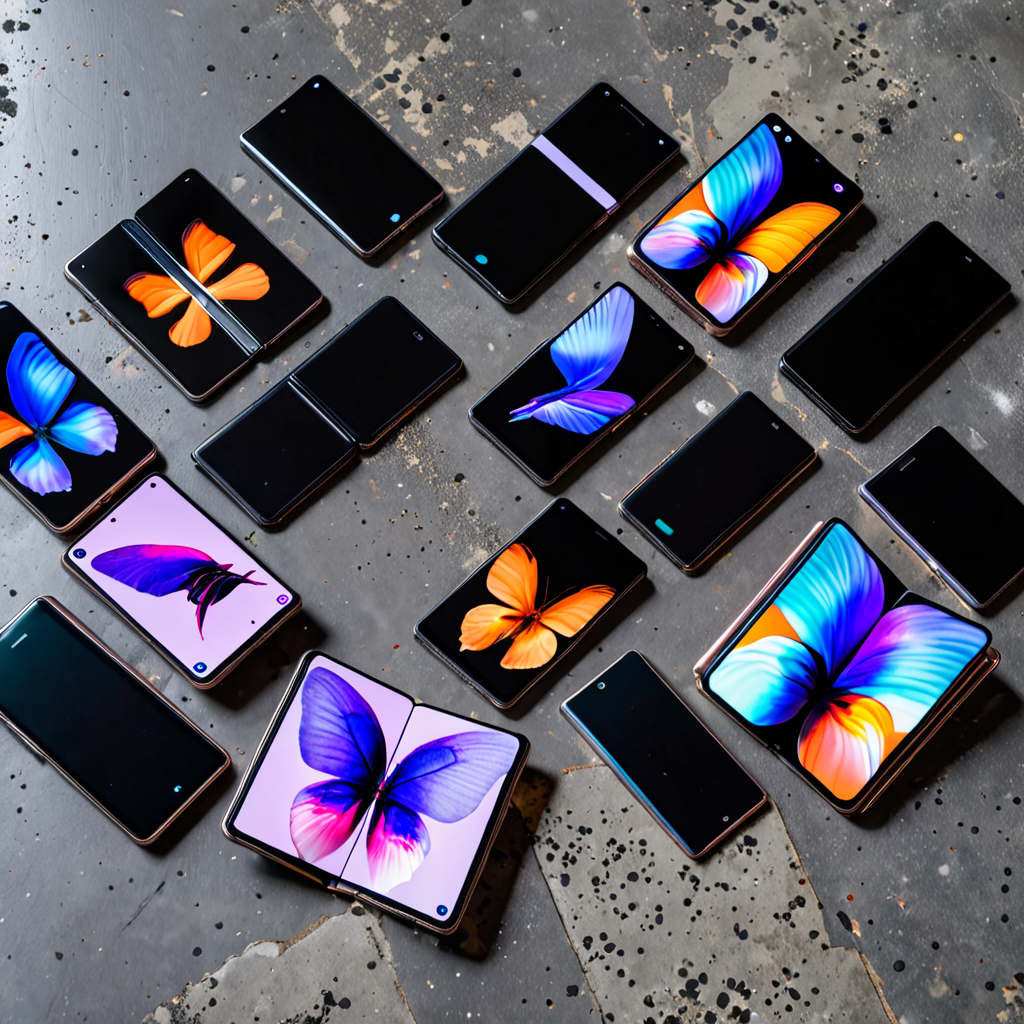
Store your foldable phone open when you’re not using it. I’ve owned 14 foldable phones across Samsung, Xiaomi, OnePlus, Honor, OPPO, Motorola, Huawei, and vivo — and none of them have ever had a screen failure. The one thing I do differently from most people: I leave them all open on my desk or nightstand when they’re not in my hand. That’s it. That’s the whole tip.
My Foldable Phone History
I should say upfront — I’m not an engineer. I’m not a display scientist. I’m just a bloke who really likes foldable phones and has bought far too many of them. Here’s the full list, because I know someone will ask:
The Samsung lot: Samsung Galaxy Z Flip 5, Samsung Galaxy Z Flip 6, Samsung Galaxy Z Flip 7, Samsung Galaxy Z Fold 2, Samsung Galaxy Z Fold 5, and the Samsung Galaxy Z Fold SE. The Chinese contenders: Honor Magic V5, Xiaomi Mix Flip, OPPO Find N3 Flip, Xiaomi Mix Fold, and vivo X Fold S. The outliers: OnePlus Open, Huawei Pocket S (the purse-style one — gorgeous device), and the Motorola Razr (2024).
That’s 14 foldable phones. Every single one of them still works. No dead pixels, no cracked inner displays, no screen protector peeling into oblivion. I’ve had some of these for years now. The Z Fold 2 is ancient by foldable standards and it’s still going strong.
Is that luck? Maybe partly. But I don’t think it’s all luck.
The Pattern I Noticed
A few years ago, I started paying attention to how I stored my phones when I wasn’t using them. Most people shove their foldable in a pocket or a bag folded shut. That’s normal — it’s what a phone is supposed to do, right? Fold up small and disappear.
But I started leaving mine open. On my desk while I’m working. On the nightstand while I sleep. Propped open at roughly 90–120 degrees, just sitting there doing nothing. Not because I read some technical paper about display stress. Just because it looked cool as a mini tablet and I was too lazy to fold it every time I set it down.
Then I noticed something. After months of daily use, my crease was barely visible. Meanwhile, friends who kept their foldables shut in pockets and bags were complaining about increasingly obvious crease lines — some after as little as six months.
I started asking around. Posting on forums. Reading threads. And the more I looked, the more the pattern held up: phones that spend more time open tend to have less visible crease wear.
Why This Might Work
Again — not an engineer. But here’s my layperson’s understanding of what’s happening inside your foldable screen.
The inner display on a foldable phone isn’t just one layer of glass. It’s a sandwich: Ultra-Thin Glass (UTG) on the bottom, a polymer protective layer on top, and usually a factory-applied screen protector on the very top of that. When you fold the phone shut, all of those layers get compressed against each other at the fold point. They’re bent around a small radius, and they stay that way — under pressure — for hours at a time if you’ve got the phone in your pocket or a drawer.
When the phone is open, those same layers are flat. Stress-free. The way they were designed to sit when displaying content. No compression at the fold line. No sustained bending force on the UTG. No pressure on the screen protector adhesive.
Think of it like a piece of paper. If you fold a piece of paper once and flatten it out, it’s fine. If you fold it and then leave it in a book for six months pressed shut, that crease is going to be a lot more pronounced when you open it back up. Same principle, different materials.
The hinge isn’t the problem. Every manufacturer has sorted the hinges by now — Samsung rates theirs for 200,000 folds, OnePlus and Honor are in the same ballpark. The hinge is mechanical and robust. The screen is the fragile bit. And the screen suffers most when it’s forced to sit in a stressed state for long stretches.
What the Community Says
I’m not the only one who’s noticed this. There’s a thread on r/galaxyzflip titled “Should I keep my phone open or closed when not in use?” and it’s a proper debate. Some people insist it doesn’t matter. But plenty of users report that keeping their phones closed has led to a more visible white crease line appearing within six months of ownership.
The screen protector issue is well-documented too. HowToGeek reported that “the inner screen protector that Samsung advised me not to replace started to come off” — and this is the number one issue foldable owners face. The protector peels at the crease because that’s where the mechanical stress concentrates. Every time you fold and unfold, that adhesive is being worked. Over time, it gives way.
If the phone spends more of its life open, the protector isn’t being flexed constantly. That’s less adhesive fatigue, less peeling, fewer bubbles forming along the fold line.
And here’s the thing that convinced me this matters: Samsung themselves are trying to fix the crease problem at a hardware level. The Samsung Galaxy Z Fold 8 introduced what they call a “Flex Titanium” display stack — a new arrangement of materials specifically designed to reduce crease visibility. That’s a massive company spending millions on R&D to solve a problem that exists because of how the display behaves when folded. They’re acknowledging the issue exists. They’re just fixing it with materials science instead of telling people to leave their phones open.
Alibaba guides for screen protector replacement recommend “ultra-thin PET film with hinge-aligned cutout” — meaning protectors that have a gap at the fold line specifically to reduce stress at that point. The entire aftermarket ecosystem is built around managing the fact that the crease area is the weak spot.
How I Store My Phones
It’s dead simple, honestly.
On my desk, whichever phone I’m currently using sits open, propped at about a 110-degree angle. Most modern foldables hold their angle quite well at that range — the hinge is stiff enough. I can glance at notifications, check the time, see a timer. It basically becomes a little desk clock when I’m not actively using it.
On my nightstand, same thing. Open, propped up, screen facing the bed. I use it as an alarm clock, which is genuinely useful. When I wake up, the phone is already open and ready to use. No fumbling, no unfolding, no awkward one-handed open in the dark.
When I leave the house, obviously I fold it and put it in my pocket. I’m not walking around with an open phone like a portable DVD player from 2004. The point isn’t to never fold it — it’s to minimise the hours it spends sitting folded under no load.
If you’ve got multiple phones (and if you’re reading this, you probably do), the open-storage approach is actually quite satisfying. Lining up three or four open foldables on a shelf looks rather impressive, if I’m honest. Not that that’s the point. But it doesn’t hurt.
The Takeaway
I can’t prove this with a controlled study. I’m one bloke with 14 phones and a theory. But after years of doing this across every major foldable brand — Samsung, Xiaomi, OnePlus, Honor, OPPO, Motorola, Huawei, vivo — I haven’t had a single screen failure. Not one.
And with Apple’s newly announced iPhone Duo, I’ll be doing the exact same thing with it. Open on the desk, stored flat, crease-free. The display materials might be different, but the physics of sustained fold stress doesn’t care about the logo on the back. If you’re picking up the iPhone Duo when it ships, bookmark this tip — you’ll need it on day one.
The manufacturers are spending fortunes trying to solve the crease problem from the inside. Flex Titanium, UTG improvements, new polymer formulations. All of that is brilliant engineering. But you can reduce the stress on your display right now, today, for free, by just leaving the thing open when you’re not using it.
Your foldable phone’s screen is most vulnerable when it’s sitting there doing nothing and folded shut. So stop folding it when there’s no reason to fold it.
Leave it open. It works.
Frequently Asked Questions
Should I keep my foldable phone open or closed when not in use?
Open. When the phone is folded, the display layers — Ultra-Thin Glass and the polymer protective coating — sit under constant compressive stress at the crease. Keeping it open eliminates that stress entirely during the hours it sits on your desk or nightstand. I’ve done this across 14 foldable phones and never had a screen failure.
Does folding damage the foldable phone screen over time?
Folding itself is designed for — manufacturers rate hinges for 200,000+ folds. But storing the phone in a closed position for extended periods keeps the display layers under sustained pressure at the fold point. Multiple users on Reddit report increased crease visibility after months of closed storage. The damage isn’t from folding — it’s from sitting folded.
How long do foldable phones last?
With careful handling, foldable phones can last 3–5 years without screen issues. I’ve personally kept phones going for years across brands including Samsung, Xiaomi, OnePlus, and Honor. The main failure point is the inner display — specifically the screen protector peeling at the crease and UTG micro-fractures — not the hinge mechanism.
What causes the crease in foldable phones?
The crease is caused by the physical fold radius of the display stack. Ultra-Thin Glass (UTG) and the polymer layer on top of it bend around a small radius at the hinge. Over time, repeated folding creates a visible indentation. Samsung’s introduction of the “Flex Titanium” display stack in the Z Fold 8 is an acknowledgement that reducing this crease requires fundamentally different materials, not just better hinges.
Why does the screen protector peel on foldable phones?
The inner screen protector is bonded to a display that constantly flexes. At the crease line, the protector experiences the most mechanical stress — stretching when opened, compressing when closed. Over hundreds of fold cycles, the adhesive weakens at that exact point and the protector starts lifting. HowToGeek documented this as the number one reported issue with Samsung foldables, and Samsung advises against replacing it yourself.
Is it safe to leave my foldable phone open on a desk?
Yes. Modern foldable phones have kickstands or can prop open at various angles. Leaving it open on a flat surface like a desk or nightstand puts zero stress on the display. The screen is designed to be used in the open position — that’s its natural, stress-free state. Many users, myself included, find it works perfectly as a small tablet or clock when propped open.
Does the hinge or the screen fail first on foldable phones?
Almost always the screen. The hinge mechanisms from Samsung, OnePlus, and others have proven remarkably durable — rated for 200,000+ folds and generally outlasting the display. The weak point is the inner display assembly: the UTG layer, the polymer coating, and the factory-applied screen protector all degrade faster than the metal hinge components.
Can I replace the screen protector on my foldable phone?
Technically yes, but it’s risky. Samsung explicitly advises against replacing the inner screen protector yourself, as improper application can damage the display. Third-party ultra-thin PET films with hinge-aligned cutouts exist on Alibaba and can work, but installation is fiddly. Some users report better results with aftermarket protectors than the factory one, but there’s always a risk of trapping dust or creating bubbles near the crease.
Will the Apple iPhone Duo need the same storage care, and will this advice apply?
Apple has just announced the iPhone Duo — their first foldable phone. The underlying display technology faces the same physics as every other foldable: sustained compressive stress at the fold point when stored closed. The same advice applies whether you’re using a Samsung Galaxy Z Fold or an iPhone Duo: store it open when you’re not using it, and the display will thank you.